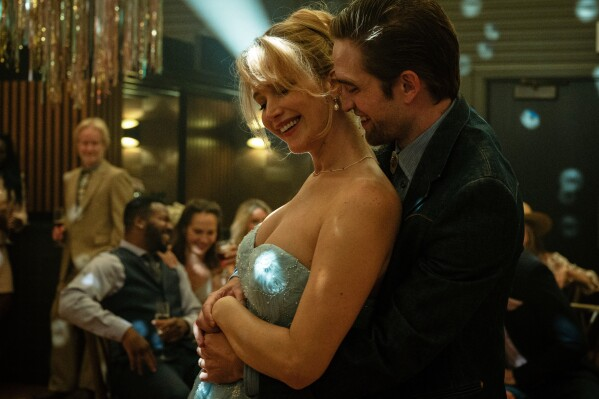
Die My Love (2025), directed by Lynne Ramsay and starring Jennifer Lawrence and Robert Pattinson, is a raw and unsettling descent into isolation and maternal breakdown. Set against the vast emptiness of rural Montana, the film traps its protagonist, Grace, in a psychological cage of grief, anger, and eroding identity. Lawrence delivers one of her most visceral performances, part feral and part fragile, capturing the frightening blur between selfhood and madness. Opposite her, Pattinson plays Jackson, her withdrawn husband — a man both tender and distant, whose silence becomes another form of suffocation. Together, their performances form a study in emotional disconnection, where love curdles into fear and indifference.
The cinematography in Die My Love is hauntingly beautiful, with every frame feeling like a portrait of emotional decay. Shot in a tight 4:3 aspect ratio, the visuals trap Grace within her own world, turning the vastness of Montana into a claustrophobic psychological chamber. The camera lingers uncomfortably close, refusing to offer distance or relief, forcing us to share in her confinement. Natural light — harsh dawns, cold twilight blues, and dim interiors — reflects her shifting mental state, while the desaturated color palette mirrors her emotional numbness. Ramsay and her cinematographer use focus and texture as emotion: blurred edges during breakdowns, razor-sharp stillness during repression. Even the house, with its cracked walls and muted tones, becomes a mirror of Grace’s mind, once vibrant but now fractured.
What makes Die My Love powerful also makes it alienating. It refuses to diagnose or explain Grace’s unraveling, instead immersing us in the chaos of her perception. That ambiguity invites both empathy and discomfort. As a meditation on mental illness and the loss of agency, it resonates deeply, but its emotional distance can also frustrate, leaving the viewer grasping for clarity that never comes. Still, it lingers like a fever dream: brutal, beautiful, and impossible to forget.